Young girls and women work (2022-24)
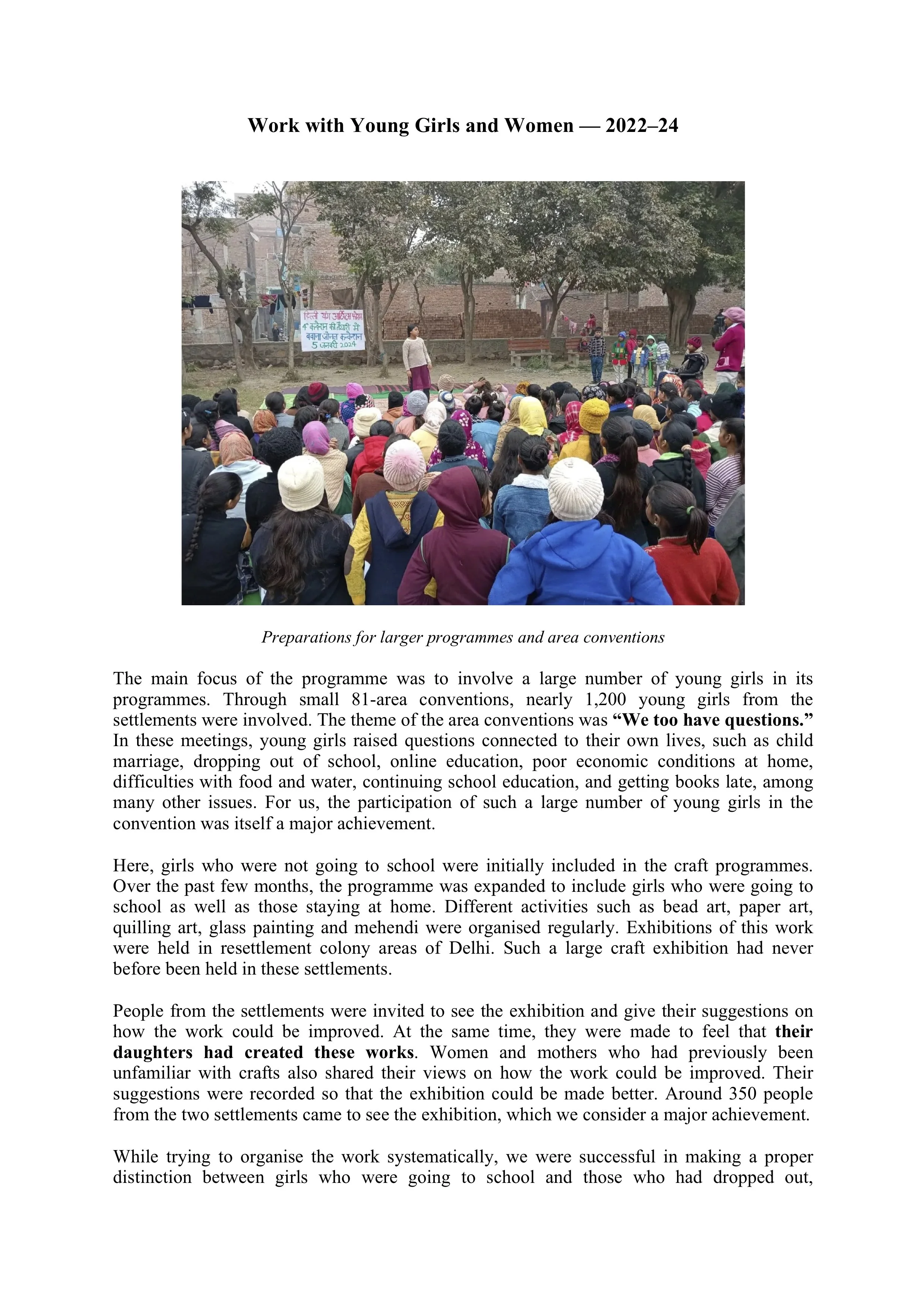
This report documents two years of work with young girls and women, from education and creative activities to conversations on health, rights and their aspirations.
It also reflects on the challenges of organising and building confidence among young women in the settlements.
30 x 30 - HOW DO WE SEE AND UNDERSTAND THE HIDDEN CONTOURS OF 30 x 30? ( 2023)

In December 2022, the framework for 30 by 30 which was conceptualized and negotiated by the Convention of Biological Diversity (CBD) was signed and declared in Montreal, Canada and it was released as the Kunming-Montreal Global Biodiversity Framework at the 15th meeting of the Conference of Parties to the UN.
In India, the government has also laid plans to fulfill the outcomes of 30 by 30. Announcements on 30 by 30 included having a balancing act between 30 by 30 and meeting the country’s developmental goals, green bonds to mobilize India’s own financial resources, and a refusal to cut farm-related subsidies.
This note examines the envisioned targets in the light of recent developments in the country.
Environment Laws in India: In the age of a Global Climate Crisis - A Dossier (2022)

In India, several changes have been introduced to environmental laws between the years 2019-2022. Several assessments have been made on the proposed changes and the effects it might have on the current environmental situation and at face value it seems they are influenced by a need by the Indian state to give easy access to companies for extracting natural resources. While this reason is integral towards explaining why these changes were introduced, influence by international mechanisms for fighting the climate crisis also needs to be taken into consideration.
It is with these concerns, a collection of articles has been compiled for researchers, activists, academicians, legal experts or anyone to get a bird’s eye view on the recent changes in the arena of environmental governance. These articles attempt to give the reader an understanding of how certain events unfolded, usually with an attempt to amend environmental laws and how it has or it will reverberate a series of irreversible damages.
मध्यप्रदेश में सिंचाई का सही आँकड़ा जानना कठिन (2022)

मध्यप्रदेश देश का ऐसा राज्य है जिसने सबसे तेज सिंचाई सुविधा उपलब्ध करवाने का दावा किया है। पिछले दशक में प्रदेश को खाद्यान्न उत्पादन की विभिन्न श्रेणियों में लगातार 7 बार कृषि कर्मण परस्कार भी मिले हैं। ऐसे में राज्य की छवि देश के अनाज के कटोरे के लिए में गढ़ी जा रही है।
हालांकि सरकारी सेवाओं के तटस्थ विश्लेषण के लिए आँकड़ों के संबंध में सरकारों का पारदर्शी रवैया बहुत जरूरी है। लेकिन, मध्यप्रदेश में सिंचाई संबंधी आँकड़ों की सार्वजनिक रूप से उपलब्धता न होने से इस पर सवाल हैं। नियंत्रक और महालेखा परीक्षक (सीएजी) ने भी अपनी जाँच में सिंचित क्षेत्र के सरकारी आँकड़ों को सच्चाई से परे पाया है। इसी संदर्भ में मध्यप्रदेश की सिंचाई क्षमता की पड़ताल करता यह लेख।
The Making of Disaster Cyclones, Coastal Vulnerability and Community Resilience (2021)

This brief report is a compilation of discussion held during webinar
“The Making of Disaster: Cyclone, Coastal Vulnerability and Community Resilience” which is aimed to bring out the challenges faced by the coastal communities, pre and post climate disaster in India. Further, it deliberated on the extent and scope of government response in terms of policy, evacuation and effective role communities play during or after disaster in this era of intensifying climate change.
वनीकरण का सामाजिक और पर्यावरणीय प्रभाव: छत्तीसगढ़ और ओड़िशा के वन क्षत्रों से एक रिपोर्ट (2021)
Due to Technical reasons, we cannot upload the publication here. Kindly write to us at admin@psa-india.net for copies.

सदियों से वनाश्रित समुदाय स्वतंत्रतातापूर्वक वन संपदा का उपयोग अपनी आजीविका, निस्तारी और जीवन को मजबूत करने के लिए करते आये हैं। परंतु, पिछले चार दशकों से वन समुदायों की वन संपदा तक पहुंच अपेक्षाकृत कम हो गई हैं। कथित विकास के कई अवधारनाओ मे से सरकार के द्वारा किया जाने वाला वनरोपण एक बड़ा कारण हैं। इस तरह के कृत्रिम वृक्षारोपण, वन और वन मे रहने वाले समुदायों पर क्या प्रभाव पड़ रहा हैं? इन्ही पहलुयों को समझने के लिए ये अध्ययन किया गया हैं। यह अध्ययन ओड़ीशा और छत्तीसगढ़ के 10 गाँव मे किया हैं। इस प्रक्रिया मे यह भी एक कोशिश थी की समुदाय के लोगों की सोच, वन के साथ जुराव और उनके पारंपरिक ज्ञान को इस अध्ययन के माध्यम से सांझा कर पाएं |

Occupation of the Coast: II Infographics booklet is an attempt to create a speaking tool for communicating the complexities of shrimp production in the country. It brings together visual insights on the micro-scales of shrimp production by encompassing labour, ecology, caste, gender, livelihoods and the economy. Each infographic acts as a companion for the five papers in Occupation of the coast-II which highlights the specific relations of production, both vertically in terms of the production process and horizontally across landscapes. We hope the infographics are able to speak, sieve and communicate the existing problematised data on shrimp production and promise an attempt at a conflict-free transition to the Blue Economy in India.
Occupation of the Coast: II
The puzzle of shrimp production on the East coast of India (2020)

Occupation of the Coast-I was published for the World Forum of Fisher People General Assembly which was held in December 2017. The focus of the first edition was to provide an overview of the changes and challenges faced by coastal communities in general, and fishworkers specifically, with regards to the Blue Economy development framework in India. Building on our learnings from this and in order to update on specific trajectories of change, this second publication focuses on intensive shrimp aquaculture on the East Coast of India.Through contributions from academics and community members from three coastal states, Occupation of the Coast-II brings together insights on the micro-scales of shrimp production by encompassing labour, ecology, caste, gender, livelihoods and the economy. An open call was put out for submissions towards this publications.
FOREST governance, implementation of forest rights act and conservation (2019)
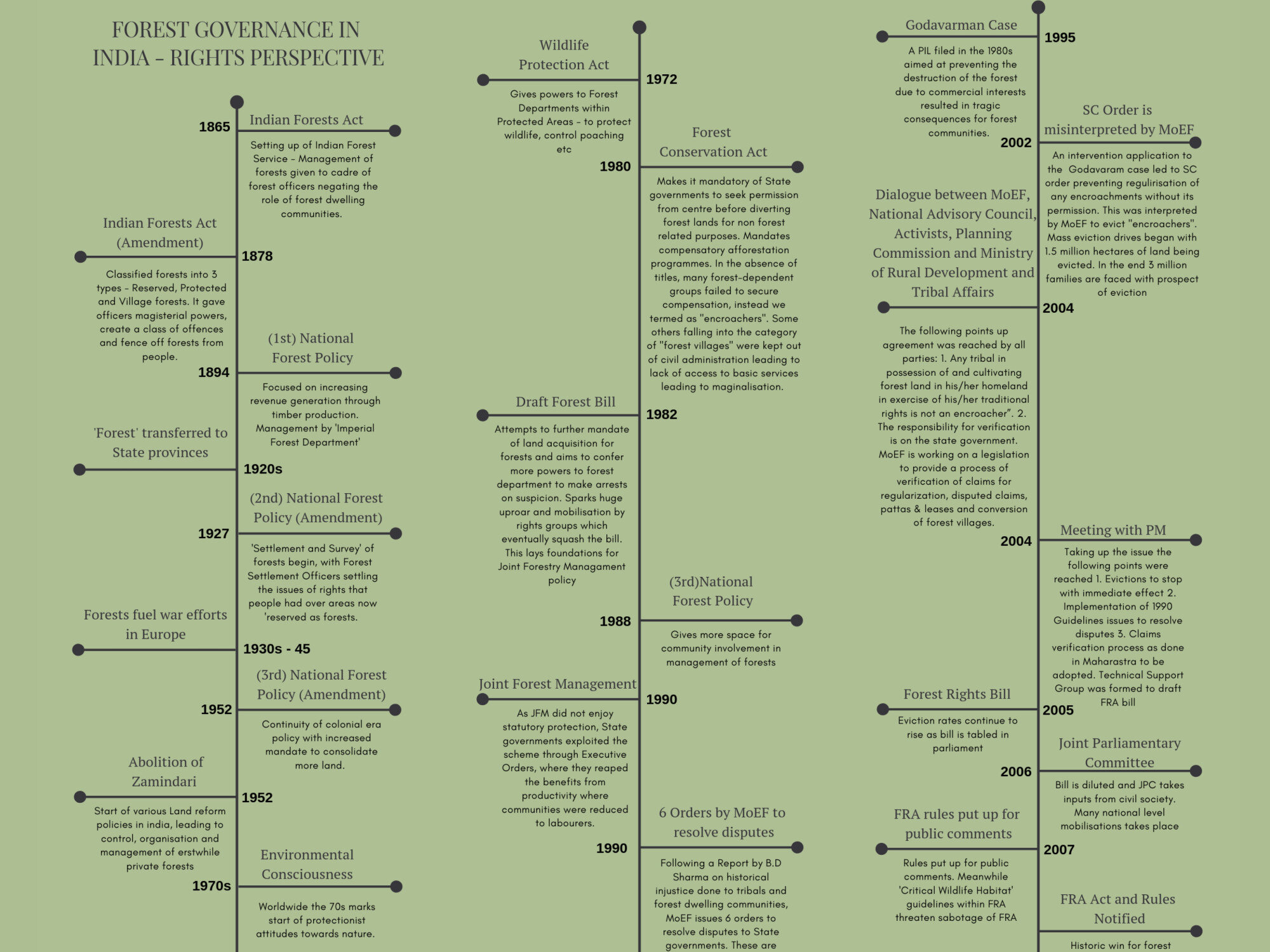
The forests in India have been a matter of significant debate and discussion where the issue of conservation is primary but there is no common understanding of what conservation stands for. Historically, the governance of the forest has been a contested issue.
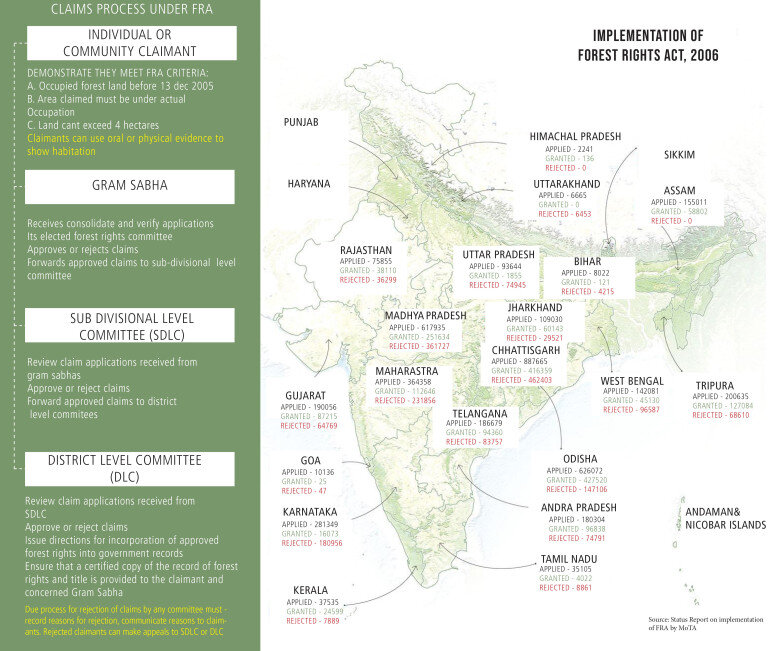
The Scheduled Tribes and Other Traditional Forest Dwelling Communities (Recognition of Forests Rights) Act 2006 (hereinafter known as FRA) intended to correct the historical injustices perpetuated on the forest dependent indigenous community and clear the path for revisiting community led forest governance and conservation. But since the act came into effect, the provisions of the Act have been systematically undermined by the government and Forest Department. There has been poor implementation of the Act in several states, loopholes in the claim verification process and perceived conflicts with the other Acts governing the forest and wildlife. The Supreme Court order for the eviction of more than a million people dependent on the forest, in February 2019, has to be looked at in the context of the situation mentioned above.
In this context, it is needed that the arguments that brought the FRA 2006 into existence and the role of forest dwelling communities in conservation be revisited and discussed.
Please find here, an infographic on the FRA.
FROM ARREST TO RELEASE: STORY OF AN INVISIBLE HUMANITARIAN CRISIS (2018)
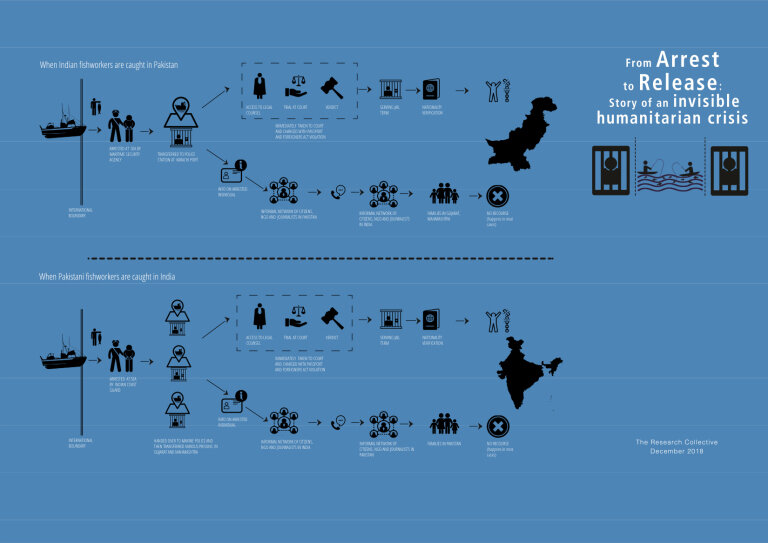

Ending the War at Sea: In Pursuit of Permanent Solutions to the India-Pakistan Fisheries conflict (2018)

The August of 2018 saw Pakistan release thirty Indian prisoners and India release fourteen Pakistani prisoners from their jails respectively; the gesture was rightly applauded by the media and citizens as an extension of an olive branch of peace, especially with the new Government in Pakistan. However, the fact that the majority of the Indian prisoners—twenty-six to be precise—are fshworkers and primarily from Gujarat and Diu, goes unnoticed. The conflict
between India and Pakistan is most often portrayed and imagined as one that takes place on land. The diplomatic turbulence brewing at sea for the last thirty years is not known to the average citizen of both countries. In fact, currently there are 103 Pakistani fshermen in Indian jails and 392 Indian fshermen in Pakistan jail. This raises many important questions of peace and security in the context of people, livelihoods, the environment and resources.
The arrests, prolonged jail-terms and in-custody deaths of the fsherpeople have given way to a humanitarian crisis. Those who manage to survive in these jails have to wait years to be released. The kind of insensitive charges, which were put on these arrested fshers, often led to their prolonged sentencing under Arms Act, Banned substances laws (Smuggling & Narcotics provisions), criminal trespassing, etc. made matters worse and mental trauma unmatched. Though the interventions in the past few years by civil society groups and the judiciary in India and Pakistan have brought some temporary relief, the fact remains that the fshworkers have been made prisoners of war, remains to be addressed. Added to it is the livelihood loss to fshers, with their captured boats, in hundreds, rotting in the other country’s custody. At the stage of prisoners release, they are packaged into political commodities or gifts by India and Pakistan to be bartered on special occasions. Ironically, within a week of the recent goodwill gesture, India arrested nine Pakistani fshworkers after they allegedly crossed over to the Indian side of International Maritime Boundary Line (IMBL) in the Arabian Sea! This situation begets many questions.
Visible Tiger; Invisible People - Study and Report Based on the Public Hearing held at Sundarban Islands, India (2017)

The Sundarban is one of the most unique forest regions in the world and is internationally recognised as an ecologically sensitive region. Criss-crossed by mighty estuarine rivers and a maze of innumerable creeks and tributaries, this is the largest mangrove forest and the only mangrove tiger land in the world. The forest spreads across India and Bangladesh of which the Indian part is situated in the state of West Bengal. The fact that it is the largest remaining natural habitat of the Royal Bengal Tiger furthers its prominence in the world.
‘Visible Tiger; Invisible People’ is a study and report that looks at the status of implementation of the Forest Rights Act 2006 in the Sundarban forest region in India. It raises critical issues and questions the current system of forest governance in the country.
It brings together the findings from the Public Hearing held at the Sundarban islands in 2016 by looking specifically at the situation of the fishworkers and forest workers in the region who are facing violations of their right to life and livelihood. It portrays the disconnect between the original ideas of forest conservation which focused on co-existence between humans, plants and animals and what is being done in reality by making areas inviolate under the garb of conservation
Where hAve the fish gone? - the impact of industrial development on fishworkers in Gujarat (2017)

Across the state of Gujarat, economic process put in motion since the ‘70s have impacted the fishing community and their livelihood. Based on fieldwork across the coast, the study, assesses the impacts of industrial development on the fishing community. It found that both industrial and fisheries policy, oriented towards export and global seafood regimes have had adverse impacts on coastal ecology and the fishing community.
Section One, focuses on the growth of industrialisation, current industrial patterns, the parallel changes in the demographic of the traditional fishing community and changing pattern of fisheries since the Eighties.
Section Two, is based on field work in four fishing villages of South Gujarat, one fishing harbour of the Saurashtra Coast and four fishing villages across the district of Kutch. It shows that large-scale pollution due to industrialisation has severely affected coastal ecology and degraded coastal areas. It has led to large-scale depletion of marine resources. The fishing community has been severely impacted – leading to their migration and displacement. Interviews also revealed changing livelihood patterns across the coast, changing access of the community to the commons, as well as the existing practices of debt bondge and militarisation in the Kutch region.
OccupatioN of the Coast - The BLue Economy in InDIA (2017)
The Blue Economy involves economic activity that engages with the various components of the oceans. Given the immensity (components and geographical scope) of the oceans, it is not surprising that a vast array of actors-state actors, transnational corporations, conservation organisations, philanthropic foundations, policy think-tanks etc.-locate themselves strategically in the framework to seize the opportunity the Blue Economy affords. As the Blue Economy gets underway, the publication titled ‘Occupation of the Coast – The Bue Economy in India’, supported by the National Fishworker Forum, re-visits various aspects of coastal development and weaves together a narrative of its impacts on the fishing communities.
The study is divided into three chapter. Chapter One studies the laws pertaining to the coastal lands and the ocean resources in tandem since they govern the space (land), the resource (ocean) and access (land to ocean) vital to the fishing communities. Chapter Two investigates current government policies and financial practices of the government’s current flagship programme, the Sagarmala Programme, followed by two two papers which explore the key thrust areas of the Sagarmala, Public-Private Partnership (PPP) port models through a analysis of the Vijhinjam Port Project and an analysis of the creation of 111 inland waterways.
Chapter Three, brings together a series of contributions on the environmental and livelihood aspects of the Blue Economy. Key issues tackled in this section are the changing role of women fishers in the fisheries sector, the legal and administrative framework of governing Marine Protected Areas in India, the introduction of Blue Carbon as a new solution to climate change, tourism policies in India and the growing concerns of militarisation and security, in context of the Andamans.
With contributions by independent researchers and organisations working on the respective issues, the report touches upon key challenges in both coastal and marine policies today. Some of the main issues that have been raised and the paper, to be written by the authors of the report, would articulate are, financialisation of natural resources, the changing nature of governance and policy regimes, the eradication of processes of consent and consultation with affected communities, and the increasing push towards privitisation and para statal bodies in infrastructure policy.
Unfolding Crisis: The Case of Rising NPAs and Sinking Public Accountability (2016)
Download Report- English and Hindi

The concept of institutionalized finance is a fairly complex issue whose nuances are often difficult to grasp. Keeping this in mind Unfolding Crisis seeks to demystify the NPA phenomenon by providing relevant facts, figures and trends to shed light on the factors leading to the crisis and also propose counter measures, which will ensure both the non-occurrence of such a situation and improve transparency and public accountability in the banking sector.
The Reserve Bank of India (RBI) in its Financial Stability Report published in June 2016 had projected that the gross NPA rate of the banking sector could increase to 8.5% of the total advances. Dr. Raghuram Rajan had also made it clear that unless the stress in the banking sector is dealt with, growth cannot be revived. To further inflate the issue, if restructured loans are included within the ambit of NPAs, the situation is likely to go out of hand, adversely impacting the overall health of the economy.
The NPA crisis is at the cusp of criticality, whereby the stability and growth of the National Economy, the Industrial Sector and the average citizen may be substantially threatened. However, before this banking anathema is countered and corrected, it must first be discussed and understood. As Henry Williams had once said, “Furious activity is no substitute for understanding”.